
I recently had the distinct honor of serving as a faculty speaker at the Maine State Bar Association (MSBA) 2026 Summer Bar Conference at the Samoset Resort in Rockport, Maine. My presentation, “Billing, Budgets, and Burnout: The Financial Drivers Behind Attorney Wellness,” addressed a critical truth that traditional wellness advice misses: attorney exhaustion is rarely a personal failure of willpower—it is a structural design flaw in a firm’s financial architecture.
As a fractional CFO for law firms, my work centers on a core operational rule: 80% of organization-wide bottlenecks are process problems, not people problems. When a firm relies on unrealistic billing targets, suffers from cash-flow panic, or operates a system designed to run hot, operational pressure lands directly on the attorneys. Effective Maine law firm management requires moving past individual remedies like mindfulness to instead re-engineer the financial systems upstream.
How Does Financial Mismanagement Violate the Maine Rules of Professional Conduct?
In standard professional services, operational chaos might just cause a bad quarter. In a law practice, structural panic actively threatens your license. Financial architecture and professional responsibility are deeply intertwined:
- Competence (Rule 1.1): Competent legal representation requires a competently managed business; systemic burnout is a direct threat to client service.
- Supervision (Rule 5.1): When liquidity problems occur ethical issues tend to occur more frequently.
- Fees & Billing (Rule 1.5): Under the weight of arbitrary or unrealistic revenue targets, systemic stress creates the exact environment that incentivizes billing shortcuts.
- Safekeeping Property (Rule 1.15): Capital shortfalls and administrative chaos are precisely when absolute trust-accounting discipline is most vulnerable to slipping.
Optimize Your Firm's Operational Health?
Transition your practice from reactive chaos to strategic data-driven growth. Download our complimentary Law Firm Tailored KPI Starter Recommendation guide to discover the metrics that protect your cash flow.
How Does Team Dysfunction Impact Law Firm Financial Metrics?
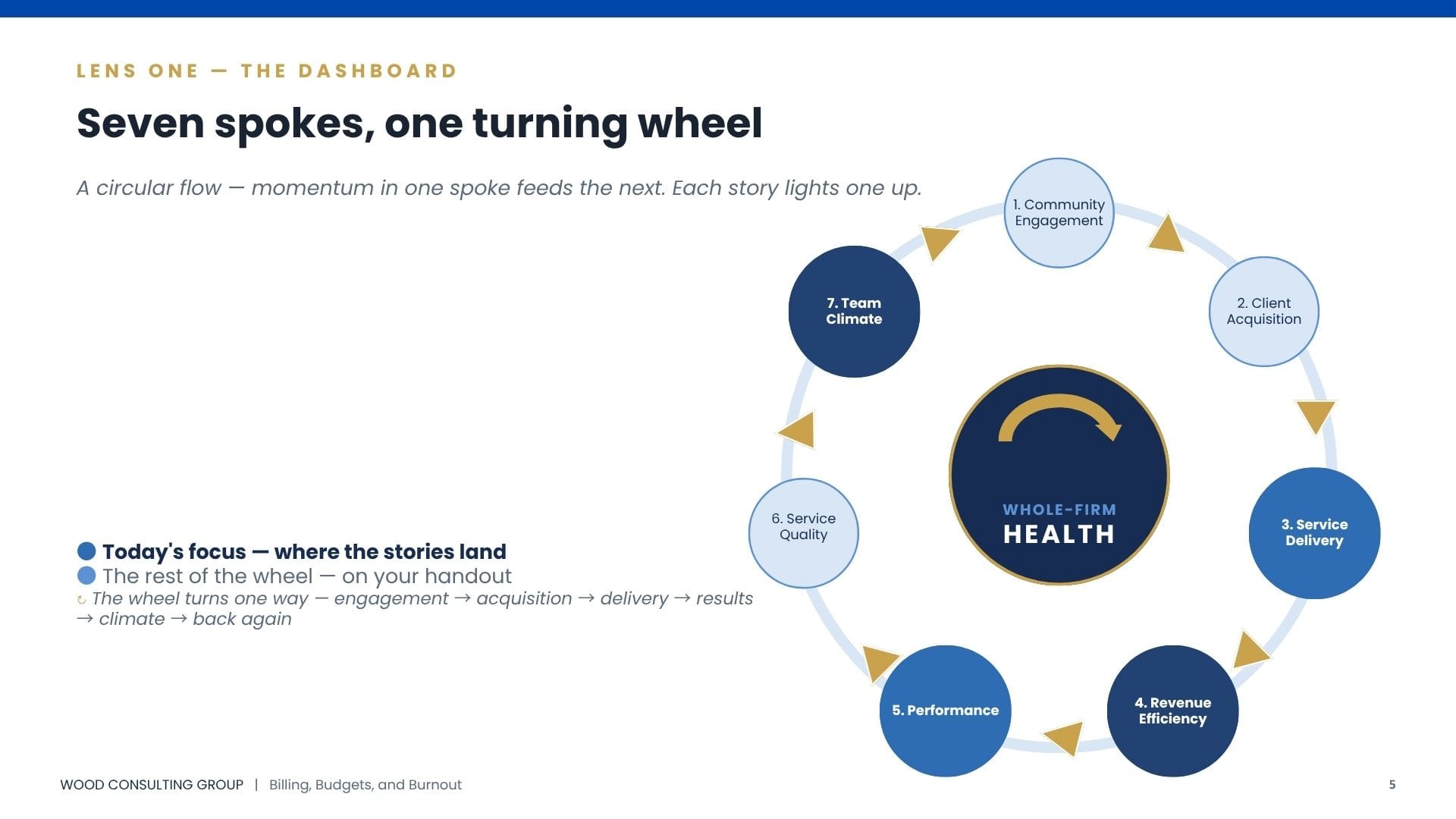
To build a sustainable practice, leadership must look through two simultaneous lenses: The KPI Flywheel (the operational metrics) and The Foundation (human behavior). Mapping Patrick Lencioni’s team dynamics model directly to a firm’s financial outcomes reveals how cultural dysfunctions drive poor financial metrics:
- Absence of Trust (Invulnerability): Attorneys hide that they are drowning, masking operational bottlenecks until deadlines are missed and collections drop.
- Fear of Conflict (Artificial Harmony): Leadership avoids tough, necessary conversations regarding partner compensation, origination credits, and underperformance.
- Lack of Commitment (Ambiguity): A lack of genuine team alignment causes new operational strategies or software implementations to completely stall.
- Avoidance of Accountability (Low Standards): Peer accountability drops, forcing all supervisory stress, client complaints, and file review back up to a single managing partner.
- Inattention to Results (Ego & Status): Leadership prioritizes individual prestige over objectively reviewing firm performance data or altering organizational design.
How Can Your Firm Build a Sustainable Financial Architecture?
Restructuring your practice for sustainable, compliant growth relies on executing three focused actions:
- Commit to a Systemic Mindset Shift: Recognize that if pressure is designed into your operating system, your people will eventually break. Move from demanding raw willpower to engineering predictable workflows.
- Isolate and Track Revenue Efficiency: Evaluate if your support staff is optimally billable and if attorneys capture time cleanly in real-time, rather than discounting or rewriting hours out of administrative panic.
- Review KPIs and Financials Together: Financial statements are lagging indicators of the past, while operational KPIs are leading indicators of the present. Reviewing them in tandem allows you to catch operational smoke before it turns into a financial fire.
Let’s Protect Your Practice
Burnout is a design flaw—and design is something you can measure, manage, and systematically change. By implementing a structured KPI Flywheel built upon a cohesive behavioral foundation, law firms replace chronic chaos with data-driven decision discipline and sustainable revenue expansion.

Connect with Wood Consulting Group to evaluate your firm’s financial architecture and help you reach compliant and sustainable growth.